top of page

Отвъд разумно съмнение

.jpeg)


Language


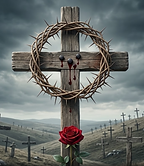


Those W Those Who Rely on Worldly Might
"Put your sword back in its place, for all who draw the sword will die by the sword." — Matthew 26:52 (cf. Revelation 13:10)ho Rely on Worldly Might
"Put your sword back in its place, for all who draw the sword will die by the sword." — Matthew 26:52 (cf. Revelation 13:10)
The dust had not settled over the ruined valley in weeks. The skies remained a perpetual, bruised purple, and the edict from the capital was everywhere: absolute allegiance to the new order, or complete exclusion from life, commerce, and safety.
In the shadow of the crumbling border city of Hazor, three men who had once grown up together found their paths converging one final time.
The First Man: Silas, Who Took Up the Sword
Silas stood in the fortified cellar of an abandoned warehouse, checking the slide of an assault rifle by the light of a single kerosene lamp. Around him were crates of stolen rations, tactical gear, and a dozen desperate fighters.
Silas believed only in what he could hold, aim, and fire.
"When the regime's enforcers come, we don't pray—we ambush," he told his men. "Power only respects greater power."
When the patrol finally breached the sector, Silas did not hesitate. He led a brutal counterstrike in the narrow alleys. For three days, his squad held the perimeter, matching brutality with brutality. But violence is an insatiable master. On the fourth night, outflanked by heavy armor and betrayed by an ally seeking immunity, Silas found himself cornered in the very cellar he had fortified.
As the door was blown inward, his weapon jammed. In his final breath, staring down the barrels of the regime’s elite guard, the ancient warning echoed in the silence of his mind: those who live by the sword will perish by it. His rebellion ended not in deliverance, but in the ash of his own making.
The Second Man: Marcus, Who Held the Crown
Two sectors over, in a cold, subterranean holding facility, Marcus sat against a damp concrete wall. His hands were bound with zip-ties; his jacket was stained with dirt and blood.
Marcus had refused to take the mark of allegiance. When the officers came to his home, he did not reach for a weapon, nor did he curse them. He had simply laid hands on his trembling family, spoken peace over them, and allowed himself to be led away.
The interrogator paced in front of him, offering a pen and a terminal. "One signature, Marcus. Denounce the Galilean, swear fealty to the Authority, and you walk out of here tonight. Refuse, and your life ends at dawn."
Marcus looked up. His body was bruised, but his eyes were clear, untroubled by fear.
"You can take my breath," Marcus whispered, "but you cannot touch the life hidden in Him. My King has already overcome this world."
At sunrise, when the cell door swung open for the execution squad, Marcus stood up on his own strength. There was no terror in his stride—only the quiet dignity of a runner approaching the finish line. He closed his eyes to the flash of a firing squad, and opened them to the promised Crown of Life.
The Third Man: Avi, The Preserved Remnant
Far to the south, amid the rocky canyons of the Judean wilderness, Avi led a caravan of weary families through the dust. They carried almost nothing—only Torah scrolls, small packs of dried bread, and their children.
For years, Avi’s family had lived scattered across distant cities, assimilated and distant from the God of their fathers. But when the global storm broke and the nations turned their wrath toward Jerusalem, something ancient stirred in his bones. The dry bones were beginning to rattle.
They had no heavy armor like Silas, nor were they trapped in the prisons like Marcus. Instead, they were driven by a strange, supernatural pull toward the ancient hills.
As enemy drones circled overhead and military convoys blocked the main highways, a path opened through the desert wadis. Springs of water appeared where dry rock had baked for centuries. Avi looked up at the mountains ahead, realizing that despite all odds, his people were being gathered from the four corners of the earth—drawn home by an unseen, unbreakable covenant.
Standing on the ridge overlooking the Promised Land at sunset, Avi fell to his knees in tears of repentance and awe. The God of Abraham had not forgotten. The scattered were being brought home.
The Three Paths
Archetype The Choice The Final Scene
The Belligerent Relied on flesh, weapons, and force Fell by the violence he chose to wield
The Faithful Martyr Endured prison and death without compromise Received the eternal victor's crown
The Remnant Awakened, repented, and followed the call Preserved and regathered to the Land
Here is an expanded and structured breakdown based on the three passages you highlighted, framing each group’s identity, posture, and biblical outcome during the Tribulation.
1. The Belligerent: Those Who Rely on Worldly Might
"Put your sword back in its place, for all who draw the sword will die by the sword." — Matthew 26:52 (cf. Revelation 13:10)
Identity: Those who attempt to navigate spiritual and global upheaval through violence, self-preservation, physical warfare, or allegiance to oppressive worldly systems.
Posture: Self-reliance, aggression, and worldly defense. Instead of relying on divine deliverance, they answer coercion with fleshly retaliation or compromise with tyrannical rulers.
Outcome: Self-destruction and judgment. Scripture indicates that attempting to defeat spiritual deception and global tyranny solely by physical means results in falling victim to the very violence and deception one employs.
2. The Martyrs & Endurers: The Faithful Saints
"Do not be afraid of what you are about to suffer. I tell you, the devil will put some of you in prison to test you... Be faithful, even to the point of death, and I will give you life as your victor’s crown." — Revelation 2:10 (cf. Revelation 12:11, 14:12)
Identity: Believers who endure severe persecution, imprisonment, and martyrdom for their testimony and refusal to conform to the dominant world system.
Posture: Spiritual steadfastness, non-violent resistance, endurance, and uncompromising faith in Christ.
Outcome: The Crown of Life and eternal reward. Though they may face physical loss, imprisonment, or death, they achieve spiritual victory through endurance and faith.
3. The Remnant: Preserved & Gathered Israel
"I will take the Israelites out of the nations where they have gone. I will gather them from all around and bring them back into their own land." — Ezekiel 37:21 (cf. Zechariah 12:10, Romans 11:25–26)
Identity: The remnant of Israel, brought through intense trial and refinement to fulfill God's covenant promises.
Posture: A journey from dispersion and spiritual awakening to national and spiritual repentance, recognizing their Messiah amid global pressure.
Outcome: Restoration, protection, and fulfillment of covenant promises. They are gathered from among the nations, reconciled to God, and established in the land.
bottom of page